 outh
outh ash
ashA Mythical Willie Mays Triple, a Matinee Hero,
and the '66 Phillies (The Original Wheeze Kids)
by Mike Walsh
View a presentation by Mike Walsh about this game in Youtube
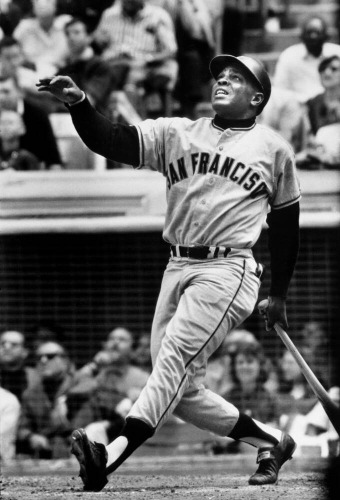 One
of my earliest memories of the Phillies is a game in the mid-60s at Connie
Mack Stadium against the great Willie Mays and the San Francisco Giants.
I went to the game with my cub scout den from Delphi, PA, which is near
Schwenksville. All I remembered about the game was that it went extra
innings, that it was on a weekend afternoon, and that Mays hit a triple,
sliding into 3rd just ahead of the throw.
One
of my earliest memories of the Phillies is a game in the mid-60s at Connie
Mack Stadium against the great Willie Mays and the San Francisco Giants.
I went to the game with my cub scout den from Delphi, PA, which is near
Schwenksville. All I remembered about the game was that it went extra
innings, that it was on a weekend afternoon, and that Mays hit a triple,
sliding into 3rd just ahead of the throw.
I also remembered that our group had seats in the bleachers on the 3rd base side, so we had a good view of that exciting play. The slide would've happened in the part of the field closest to us. I treasured the memory, thinking of the Mays' triple as one of the most exciting baseball plays in sports. But I couldn't remember the date, score, or anything else about the game, like who won. And over the years, I even wondered if I'd imagined that wondrous triple.
Examining the Phillies schedule in the mid-60s on Baseball Reference, I found that there was just one weekend afternoon games against the Giants that went extra innings in the mid-60s: Saturday, July 16, 1966. 1:37 pm start. 15 innings. That was it! Here's the box score and play-by-play details.
I also tracked down the Philadelphia Inquirer sports section for July 17, 1966, which featured a couple of articles about the game. Turns out that this game that I hardly remembered was very exciting and very long--3 hours and 49 minutes.
The Phillies lineup that day featured stalwarts from a strong roster--Johnny Callison, Dick Allen, Cookie Rojas, and Tony Taylor. It even included future celebrity announcer Bob Uecker, the backup catcher who started that day, and Bill White, the future National League president.
Back then, the Giants were perennially one of the best teams in the 10-team National League. Besides Mays, they had stars like Willie McCovey, Matty and Jesus Alou, Juan Marichal, Gaylord Perry, and a 44-year-old Warren Spahn.
1966 All Star Game
 The
series started on July 14, 1966, two days after the 1966 All-Star Game,
which was held on Tuesday afternoon, July 12, at Busch Stadium II, St.
Louis. It was 103 degrees at game time for the All Star game. The temperature
on the field was reportedly much higher. Numerous fans in the stands fainted
during the game from heat exhaustion.
The
series started on July 14, 1966, two days after the 1966 All-Star Game,
which was held on Tuesday afternoon, July 12, at Busch Stadium II, St.
Louis. It was 103 degrees at game time for the All Star game. The temperature
on the field was reportedly much higher. Numerous fans in the stands fainted
during the game from heat exhaustion.
The Giants had six players in the game: Mays, McCovey, Marichal, Gaylord Perry, as well as catcher Tom Haller and 3rd baseman and outfielder Jim Ray Hart. For the Phillies, Dick Allen and Jim Bunning. Denny McClain and Sandy Koufax were the starting pitchers.
The NL won 2-1 in 10 innings when Maury Wills singled home Tim McCarver for the winning run. Perry pitched two innings for the win. Of the Giants and Phillies onn the NL roster, only Haller did not get into the game.
Games 1 and 2 of the Series
When the Giants got the Philadelphia after the break, they were embarking on a six-game road trip. They were in first place in the National League and had been for most of the season, but they had been inconsistent since a 12-game winning streak in May. When they arrived in Philadelphia, the Giants were up just one game up on the second-place Pittsburgh Pirates.
The Phillies were in 4th, seveen games back with a 46-39 record. Oddly, the Phillies had scored more runs and allowed fewer than the Giants at that point of the season.
On Thursday night, the first game of the series, Larry Jackson needed just 98 pitches for a complete-game shutout of the Giants. Giants' starter Gaylord Perry, who had a 12-1 record in the first half of the season, was relieved during the Phillies’ four-run fourth inning. Perry had pitched three times in 6 days, so it's not a surprise that he had a letdown. After that loss, the Giants trailed the Pirates by percentage points.
Phillies fans will remember that the 35-year-old Jackson was acquired, along with 37-year-old starter Bob Buhl, in April in an infamous trade that saw Ferguson Jenkins, Adolfo Phillips, and John Herrnstein being sent to the Cubs. Jenkins went on to win 284 games and was later inducted into the Hall of Fame.
The next night Marichal went nine strong innings, holding the Phils to one run, for his 15th win of the season. Mays homered against Bunning, the 526th of his career. San Francisco was back in first.
The Saturday afternoon game on July 16 was the rubber match, and both teams had doubleheaders the next day, the Giants in Pittsburgh and the Phillies hosting the Dodgers. What the Oakland Tribune described as a “whooping, screaming” crowd of 31,5311 included more than 16,000 kids and women who took advantage of a free-admission promotion.2 I was one of them.
Buhl started for the Phillies vs. versus 25-year-old lefty Ray Sadecki for the Giants.3 It was 82 degrees and partly cloudy with 30% humidity, perfect weather for baseball.
Lineups:
Phillies |
BA |
OBP |
SLG |
OPS |
Giants |
BA |
OBP |
SLG |
OPS |
Cookie Rojas, CF |
.270 |
.306 |
.340 |
.646 |
Bob Schroder, SS |
.273 |
.273 |
.273 |
.545 |
Johnny Callison, RF |
.281 |
.336 |
.426 |
.762 |
Jim Davenport, 3B |
.254 |
.317 |
.405 |
.722 |
Dick Groat, SS |
.235 |
.280 |
.317 |
.598 |
Willie Mays, CF |
.278 |
.348 |
.550 |
.898 |
Dick Allen, 3B |
.315 |
.392 |
.676 |
1.068 |
Willie McCovey, 1B |
.296 |
.375 |
.543 |
.918 |
Harvey Kuenn, LF |
.237 |
.275 |
.329 |
.604 |
Jim Ray Hart, LF |
.286 |
.360 |
.527 |
.887 |
Bill White, 1B |
.285 |
.361 |
.486 |
.847 |
Jesus Alou, RF |
.246 |
.257 |
.285 |
.542 |
Tony Taylor, 2B |
.256 |
.310 |
.370 |
.679 |
Tom Haller, C |
.239 |
.320 |
.507 |
.828 |
Bob Uecker, C |
.238 |
.328 |
.438 |
.766 |
Tito Fuentes, 2B |
.257 |
.281 |
.336 |
.617 |
Bob Buhl, P |
Ray Sadecki, P |
||||||||
| Subs | |||||||||
Tony Gonzalez, CF |
.273 |
.329 |
.394 |
.723 |
Hal Lanier |
.198 |
.235 |
.263 |
.498 |
Clay Dalrymple, C |
.283 |
.401 |
.397 |
.798 |
|||||
Phil Linz, SS |
.241 |
.255 |
.296 |
.551 |
Mays was 35 that year, and he hit .288, with 37 HR, and 103 RBI. 1966 was actually a down year for Mays, as he had raked .317, 52 HR, and 112 RBI in 1965, one of his two MVP years. By the way, Mays also won Gold Glove awards every year from 1957 through 1968. He was alsol an All Star every year from 1954 to 1972. Say hey, indeed!
Mays batted 3rd for the Giants and went 2 for 7 with two runs scored, both hits coming off Buhl in regulation. But the box score showed no triple. Just a single and a double. What!? Had I dreamt that perfect feet-first slide into 3rd, one of my most cherished baseball memories? Say it ain't so!
1966 Phillies Rebuild: Opposite of the Process
Before we get any further into the game, let's review the unique approach Phillies management took that year to contruct their roster. In 1966, the Phillies were two years removed from their disastrous 1964 season. They had spent most of '64 in first place and were poised to win their first pennant in 14 years, but they fell apart during the last two weeks of the season. They lost 10 in a row and finished one game behind the eventual World Series-winning St. Louis Cardinals.
But in '66 they still had a solid core from that team: Richie Allen, Johnny Callison, Bobby Wine, Tony Taylor, Cookie Rojas, Tony Gonzalez, and strong starting pitching led by Jim Bunning and Chris Short.
After coming in sixth in 1965, the Phillies general manager John Quinn and manager Ray Mauch thought that the team was just a few pieces short of another run for the pennant. They didn't want to trade any of their starters, so for the 1966 season, the Phillies did something unusual: through waiver pickups, player purchases, and trades of younger players, they added several accomplished but past-their-prime veterans. These were mostly players near the ends of their careers.
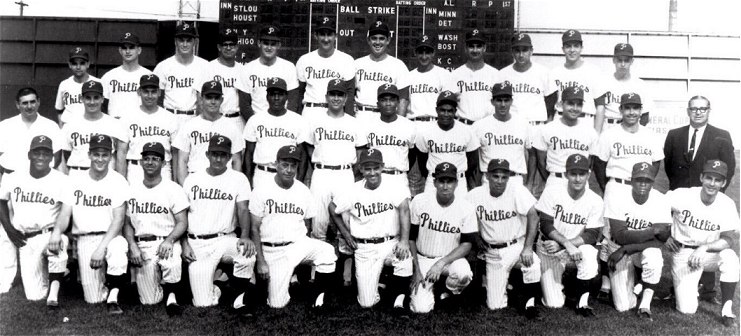
Front row: Briggs, Clemens, Rojas, Oldis (coach), Myatt (coach),
Mauch (manager), McLish (coach), Lowrey (coach), Fox, Allen, Groat.
Middle row: Liscio (trainer), Herbert, Wine, Brandt, White, Callison,
Gonzalez, Taylor, Linz, Knowles, Dalrymple, Meister (traveling secretary).
Back row: Bush (batboy), Culp, Bunning, Kuenn, Short, Craig, Jackson,
Uecker, Buhl, Roebuck, Wise, Barlow (batboy).
It was a rebuild of sorts--in reverse--the opposite of the infamous "Process" rebuild that the Sixers and Sam Hinkie tried a few years back. The Sixers got rid of veteran players, replaced them with draft picks, and accepted the inevitable losing seasons--aka, tanking. The 1966 Phillies kept their good players and added older veterans in an effort to win it all that year. As it turns out, neither approach was successful, although it's easy to see why Quinn and Mauch thought it was worth the risk.
The first sign of the veteran makeover came on October 27, 1965, when the Phils traded three players in their 20s to St. Louis Cardinals for Dick Groat, Bob Uecker, and Bill White, all in their 30s. They then made minor moves during the winter, picking up part-time players like Phil Linz, Jackie Brandt, and Doug Clemens.
On April 21, 1966, after the start of the season, the Phillies made one of the worst trades in team history: they sent Ferguson Jenkins and two other backups, all in their 20s, to the Chicago Cubs for 35-year-old Larry Jackson and 37-year-old Bob Buhl. Jackson and Buhl were very good pitchers, especially earlier in their careers. At the time of the trade, Jenkins had spent most of his career in the minors, but he'd go on to pitch in the majors for the next 18 years, win 284 games, and earn a place in Cooperstown.
Why did the Phillies feel that they had to strengthen their pitching staff? Because several of the pitchers the Phillies were counting on to contribute in 1966 were injured or ineffective and didn't make it out of spring training with the club. This list included Gary Wagner, who had pitched in 56 games out of the pen in 1965 as well as Ed Roebuck, John Boozer, and Grant Jackson, who were sent down at the end of spring training. Bo Belinsky and Ray Culp made the team but were ineffective and rode the bench.
The Phillies also picked up veteran relievers Terry Fox, 36-year-old Roger Craig, and 37-year-old Steve Ridzik not long after. But Ridzik was released within a month of signing, and Craig lasted just a couple months.
Phillies roster moves before and during the first few months of the 1966 season. As you can see, they turned over half their roster desperately trying to build a contending team.
| Players added:
|
Players traded:
|
The Original Wheeze Kids
Following the big trade with the Cubs, Philadelphia Daily News columnist Stan Hochman referred to the 1966 Phillies and their over-the-hill additions as the Wheeze Kids, a clever take on the nickname of the 1950 Phillies, the Whiz Kids, who reached the World Series.4
"What the Phillies appear to be doing is trying to win a pennant with a dynasty almost as old as the Ming dynasty...," Hochman wrote. "The Phillies are making a no-holds-barred bid for a pennant in 1966, and never mind about the future."
The age-related jokes wrote themselves.
Larry Merchant, another Daily News columnist wrote: “The laughter at Connie Mack … will turn to whimpers if all the ancients the Phillies are collecting turn out to be Don Hoaks. With six pitchers in their mid to late 30s, and three regulars in their early to mid 30s, the Phillies need a geriatrician instead of a trainer…."5
Merchant continued, “By turning Connie Mack Stadium into a rest home, it is evident that Quinn and Mauch have gone just about as far as they can to bring a pennant to town. If this doesn’t do it … it’s Geritol for the Phillies and hemlock for management.”
In July of 1966, Mauch told Daily News writer Bill Conlin, “We’ll win it. I know we’ll win it. I've never been surer of anything in my life... It’s the most professional team I ever managed….men who have been here before.”6
"Mauch reasoned that Jackson and Buhl would win between 25 and 30 games between them," Conlin wrote. "He called his starting alignment of Jim Bunning, Chris Short, Jackson, Buhl, and Culp as strong and experienced as any in the league. He knew the team would score more runs. How was any righthander going to wade through a gauntlet of Rojas, Groat, Callison, Allen, White, Gonzalez, and Clay Dalrymple? And Brandt and Uecker would put more pressure on lefthanders."
The Game
 The
game on Saturday afternoon, July 16, 1966, was scoreless until the top
of the 4th when the Giants’ Jim Davenport hit a homer off the upper-deck
facing in left-center.7 The Giants got another run
that inning after a Mays double and McCovey’s RBI single.
The
game on Saturday afternoon, July 16, 1966, was scoreless until the top
of the 4th when the Giants’ Jim Davenport hit a homer off the upper-deck
facing in left-center.7 The Giants got another run
that inning after a Mays double and McCovey’s RBI single.
The Phils picked up a run with some small ball in their half of the fourth (walk, single, and sacrifice fly), and Uecker tied things up in the fifth with a solo shot to left, his seventh and final homer of the season. (Uecker’s 7 HR that year were half of his career total of 14.)
The top of the sixth featured three Giants hits and three Phillies errors, which resulted in a 5-2 Giants lead. Mays started the rally with a single off Buhl and advanced to 3rd on a two-base error by Cookie Rojas, the Phillies' centerfielder that day. (Rojas usually played 2nd base.) So Mays didn't hit a triple, but I did see him slide into 3rd on a close play. What a relief! I was at least half right.
White, who started his career with the Giants in the late 1950s, hit a two-run homer, his 16th of the season, in the bottom of the sixth to keep the score close.
But this game wasn’t exciting enough for the cub scouts. As I dimly recall, by the 6th or 7th inning the scouts weren’t paying attention. Most of us were either sleeping, bickering, napping, wandering the bowels of the stadium, or just staring at nothing in particular.
Going into the bottom of the 9th, the Phils were down to the Giants, 5-4. Tony Gonzalez replaced Rojas in center and opened the inning with a single.
A bunt and a ground out later, and Gonzalez was on 3rd with 2 outs. Phil Linz, a backup infielder for the Phils who had taken over for Phil Groat at shortstop, hit a chopper to 3rd.
As Frank Dolson of the Inquirer reported, "The ball took a high hop and glanced off the glove of 3rd baseman Jim Davenport," allowing Gonzalez to score.8 Tie game. Extra innings.
"I thought he'd catch it," Linz said about his game tying hit. "It was, well ... a miracle."9 Davenport was not charged with an error on the play.10
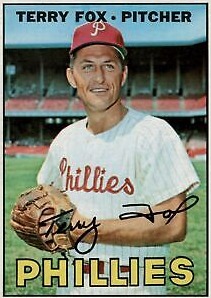
The Phillies brought right-handed reliever Terry Fox into the game in the 10th. Fox had been purchased from the Tigers in May, and he proceeded to shut out the mighty Giants for six innings. In three of those innings, the leadoff batter got on, but Fox pitched out of a jam each time. In the 11th, for example, the first two batters singled -- 1st and 3rd, no outs. A bad situation. But the next batter hit into a double play, and luckily the runner on 3rd didn't go. A fly ball out, and the inning was over, still tied.
Giants reliever Frank Linzy matched Fox with scoreless innings, and the game moved to the bottom of the 15th with the score still tied. The Giants brought in reliever Joe Gibbon.
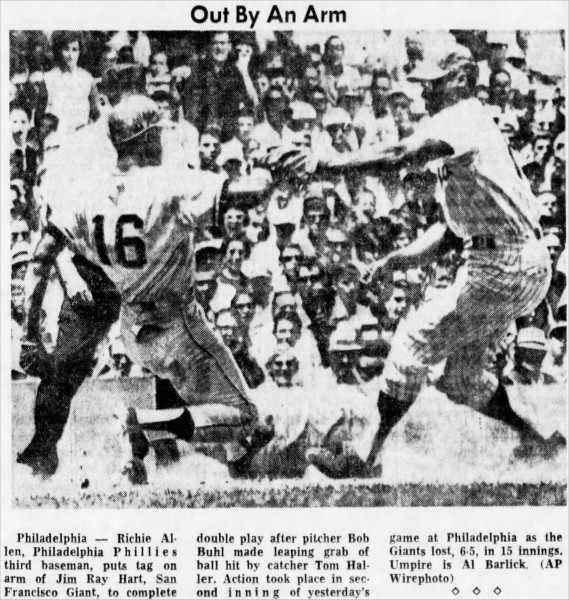
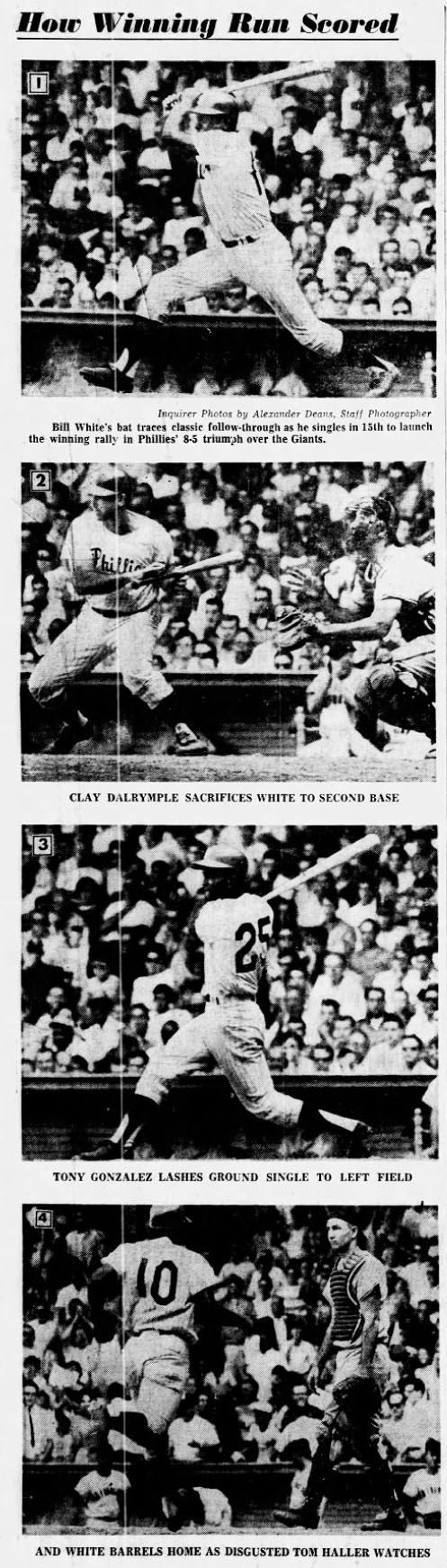
White singled. Clay Dalrymple, who had replaced Uecker behind the plate, bunted White to 2nd. Gonzalez then singled to left on the first pitch. The Giants leftfielder, Jim Hart, fumbled the ball, allowing White to score, ending the game.
The Inquirer called the game a "thrilling, come-from-behind triumph."11 I'm sure the cub scouts and our den master cheered just so we could finally load into the bus and go home.
Terry Fox, a Short but Sparkling Career
Reliever Terry Fox pitched six shutout innings for the Win. Relief pitchers rarely pitch that long, then or now, and he held the formidable Giants offense to only four hits. Mays went 0-3 against Fox. The Inquirer wrote an article about him the next day, calling Fox a "Matinee Hero."12
At age 91, Fox now lives in New Iberia, Louisiana. After some internet sleuthing, I found his phone number and called him.
"I remember the game because it went extra innings, and we were able to control it and win," he told me. "That made a big difference. I did what the Phillies got me for. The Giants were trying to get to the championship. I also remember the umpire telling me after the game that it was the best game he had ever seen."13
It was Fox's longest game for the Phils but, as he pointed out, it wasn't the longest of his career. That was in 1962 when he pitched for the Detroit Tigers.
"We were playing the Yankees in Detroit. Saturday afternoon. The game went 22 innings. 7 hours. I came in in the 12th and pitched eight innings of shutout ball. Phil Regan relieved me, and a backup outfielder hit a home run. And then we didn't score, so the Yankees won."
Fox also pitched 7 1/3 innings in relief for Detroit on June 11, 1963, in a 15-inning game against the Red Sox, in which he took the loss.
About his pitching style, Fox says, "I wasn't an over-powering pitcher, but I could throw a curveball, a good changeup, and a sinker-type pitch. I kept the ball low, and I threw a lot of strikes. The infielders knew how I pitched, and they expected the ball to be hit on the ground."
Terry Fox’s career stats bear this out. In seven major league seasons, he faced 1,664 batters, issued only 124 walks, hit only 12 batters, threw just six wild pitches, and committed just one balk.
 I
mentioned the Phillies infamous late season collapse of 1964 to Fox, and
he told me about the Tigers' similar collapse in 1961, his rookie year.
Detroit finished 2nd in the AL with a record of 101-61 that year, a record
that was normally good enough to win the pennant. But the Yankees went
109-53.
I
mentioned the Phillies infamous late season collapse of 1964 to Fox, and
he told me about the Tigers' similar collapse in 1961, his rookie year.
Detroit finished 2nd in the AL with a record of 101-61 that year, a record
that was normally good enough to win the pennant. But the Yankees went
109-53.
The Tigers spent 83 days in 1st place that year. With hitters like Norm Cash, Rocky Colavito, and Al Kaline, the Tigers scored more runs than the vaulted Yankees, 841 to 827.
But the Tigers lost 11 of 13 games between Aug 28 and Sept 10th and dropped to 11 1/2 games back. They were out of it, a collapse almost as bad as the Phils' epic 1964 choke. The Yanks went on to beat the Reds in the 1961 World Series 4 games to 1.
Another painful memory for Fox came on September 17 of that same season, another game against the Yankees at Tiger Stadium that went extra innings.
"I was pitching in the 12th inning and Tony Kubek got a hit. Next up was Roger Maris. I think it was a 2-1 count, and he hit the ball out of the park." That was Maris' 58th home run of the year, and the Yankees won the game. A couple weeks later, on the last day of the season, Maris hit his 61st homer of the season, breaking Babe Ruth's single season home run record, set in 1927.
Fox appeared in 39 games for the Tigers that season as a rookie reliever, had a 5-2 record, 12 saves, and an astonishing 1.41 ERA. He allowed only nine earned runs all season. He was 25 years old. Fox didn't get any votes for Rookie of the Year in 1961, but he should have.
Johnny Callison and Dick Allen
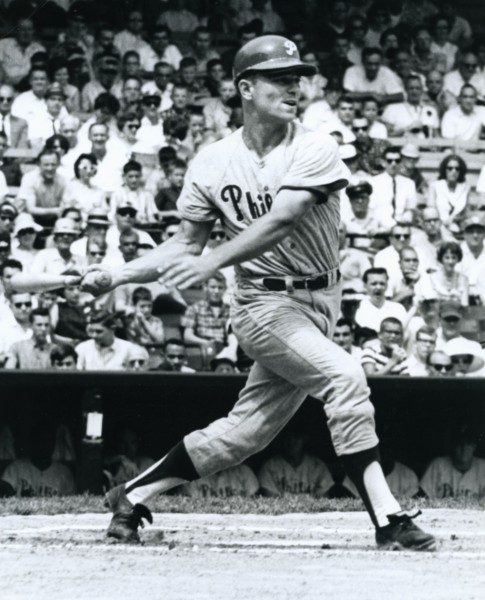
Johnny Callison had an off day that afternoon, taking a rare 0 for 6. In both 1964 and 1965, Callison hit over 30 HR and had over 100 RBI. He was an All Star both years, and who can forget his walk-off 3-run homer to win the 1964 All Star game at Shea?
But 1966 was the beginning of the painful decline in Callison's batting power. He hit a respectable .276 and led the NL with 40 doubles, but he hit only 11 homers and had only 55 RBI. He would not hit 20 homers in a season again, and he never again approached his All Star power numbers.
 I
remember the Philly newspapers speculating about psychological issues
as the cause of his diminishing power. They also questioned if he needed
glasses. It's still puzzling. At age 27 in 1966, when he should have been
reaching his peak of athleticism and strength, his power abandoned him.
Callison spent the early 70s with other clubs, and he retired in '73 after
hitting just one round tripper in 45 games with the Yankees.
I
remember the Philly newspapers speculating about psychological issues
as the cause of his diminishing power. They also questioned if he needed
glasses. It's still puzzling. At age 27 in 1966, when he should have been
reaching his peak of athleticism and strength, his power abandoned him.
Callison spent the early 70s with other clubs, and he retired in '73 after
hitting just one round tripper in 45 games with the Yankees.
In addition to his early career offensive prowess, Callison was one of the best defensive outfielders of his era. He lead all NL right fielders in putouts and assists for most of the 1960s. He was also in the top 5 for initiating double-plays from right field for most of the '60s, and he was 1st in the RangeFactor defensive measure for right fielders in the '60s. But sadly, he never won a Gold Glove. In those days, Roberto Clemente, Mays, and Curt Flood dominated the Gold Glove awards for NL outfielders.
Richie Allen also had a quiet day, going 2 for 7 with no RBIs and 2 Ks. But Allen had a monster year in 1966--second in the NL with 40 HR, third with 110 RBI, and fourth with a .317 batting average. In fact, he lead the National League in OPS and Slugging % and finished fourth in the NL MVP vote. He would have three more good years with the Phillies before being traded to St. Louis in the infamous Curt Flood deal. Allen went on to win the AL MVP with the Chicago White Sox in 1972.
By the way, in 1965, Allen hit what may be the longest home run in Phillies history: a monster 529 foot smash over the left field roof of Connie Mack Stadium.
Fates of the Wheeze Kids
In no particular order, here are players acquired by the Phillies for the 1966 season:
- Bob Buhl, the Phils' starting pitcher that day in
1966 against the Giants, had a great 15 year career: 166-132 Win-Loss
record, 3.55 career ERA, 20 shutouts, 11 complete games. Not Hall of
Fame numbers but darn good nonetheless. He spent the first half of his
career with the Milwaukee Braves, then four seasons with the Cubs. The
next year, 1967, he pitched only three innings for the Phils and was
released in May. But in 1966, he helped form a formidable starting rotation
for the Phils.
- Larry Jackson had a 14-year career as illustrious
as Buhl's. Jackson appeared in 5 All Star games, won 24 games in 1964,
and was 2nd in Cy Young voting that year. He pitched through 1968 for
the Phillies.
- Bill White was 32 when he was traded to the Phillies
and had spent most his career with St Louis. He had 22 HR and 103 RBI
for the Phillies that year, and he was the only veteran they acquired
that season with any power. He played in 1967 and 1968 with Philly before
being traded back to St. Louis before the 1969 season, where he got
just 68 at bats before retiring. White's career was substantial as well:
8 All Star Games, 7 Gold Gloves, 1,702 hits, 202 HR, 870 RBI, and a
.286 career batting average. He later served as President of the National
League, becoming the first African-American to hold such a high position
in sports.
- Bob Uecker was a backup catcher for the Phils in
1966, but he played just 18 games with the team the following year.
He played 62 games with Atlanta before he was released at the end of
1967 and retired. He went on to a long career as an announcer for the
Milwaukee Braves and TV pitchman.
- Dick Groat was one of the best players the Phils
acquired that year, but he was 35. He had spent most of his career with
the Pirates. Groat had been an All American at Duke in both baseball
and basketball, and in 1953 he played in the NBA. During his 15 year
career, he had a .286 lifetime batting average, 2,138 hits, was the
NL Rookie of the Year in 1952, NL MVP in 1960 when he hit .325, and
MVP runner up in 1963 with the Cardinals when he hit .319. He appeared
in eight All Star games. In 1967, Groat played 10 games with Phillies
and 34 more with the Giants before retiring. He was eventually elected
into both the College Baseball and College Basketball Halls of Fame.
He died on April 27 of this year.
- Jackie Brandt, a veteran outfielder, appeared in
the game against the Giants but only as a pinch runner. He also had
a long career in the majors, starting in 1956 with the Cardinals. His
most productive years were in the early 60s with Baltimore. He appeared
in two All Star games, won one Gold Glove, and had over 1,000 hits and
112 HR. Brandt hit .250 for the Phillies that year. The next year he
was picked up by Houston but hit only .213 as a part-time player and
was released at the end of the 1967 season and retired.
- Harvey Kuenn may have been the most accomplished
player added by the Phils for the past-their-prime rebuild. He was purchased
by the Phils from the Chicago Cubs on April 23. Despite hitting a very
good .296 that year in 86 games, 1966 would be his last year in the
big leagues. He was 35, and he ended his 15-year career with stats similar
to Groat's: 2,092 hits, a .303 lifetime batting average, 1953 AL Rookie
of the Year, and 8 time All Star. In 1959, he hit .353 for the Tigers,
the top batting average in the AL. He also lead the AL in hits for four
seasons in the 1950s. He played most of his career as a shortstop, but
by 1966, he had lost speed and range, so Mauch played him part-time
in left. The Phils released Kuenn after the 1966 season. He went into
coaching and by 1982 he was the manager of the Milwaukee Brewers, who
went to the World Series but lost in seven games to St Louis.
- Roger Craig was another player from the 1966 Phils
who would later make a name for himself in coaching. In 1966, the 11-year
vet was 36 years old. In April, he was released by the Reds and immediately
picked up by the Phils. During the next couple of months, he made 14
relief appearances for the Phils, but his ERA was a high 5.56 and he
was released on July 23, just one week after the 15-inning game that
I attended. Craig finished the season in the minors before retiring.
He went on to coach in the majors for 25 years. He died on June 4, 2023.14
- Phil Linz had a .200 BA in 1966 (and a .465 OPS).
On July 11, 1967, the Phillies traded him to the Mets for Chuck Hiller,
another light-hitting utility infielder. Linz hit .211 in 1967 and .209
in 1968 for the Mets and retired at end of season. The highlight of
his career was batting leadoff for the Yankees in the 1964 World Series
against the Cardinals. Linz hit two solo HRs in that series, including
one off Bob Gibson in 9th inning of game 7, but it wasn't enough. Linz
batted .226 in that World Series. He is also famous for an odd incident
with Yogi Berra involving a harmonica on the Yankees team bus.
- Reliever Darold Knowles appeared in 69 games for
the 1966 Phillies with a 3.05 ERA. But that didn't stop the Phillies
from trading him after the season to the Washington Senators for centerfielder
Don Lock. Knowles pitched in the bigs until 1980 with 1,092 IP, 143
saves. He also went to three World Series with the A's in the 1970s.
The Phils should have kept him.
- Ray Herbert had been picked up by the Phils in 1965,
during which he started 19 games. But in 1966, when he was 36, he pitched
almost exclusively in relief. The 15-year vet, who had spent most of
his career in the AL, was released after the '66 season and retired.
- 1966 was Terry Fox's last season in the majors too and his only one with the Phillies. He had spent seven years in the minors and seven years in the big leagues, mostly with Detroit. He finished with a 29-19 record, all in relief, with 59 saves and a 2.99 career ERA. He retired in 1967 after a year in the minors and accumulating shoulder injuries.
1966 and Beyond: The Sad Decline
After the marathon game on July 16, 1966, against the Giants, the Phillies were 48-40 and still in contention. The Phillies finished 1966 with a very respectable 87-75 record, but that record was no better than 4th in the 10-team National League.
The Giants had more success that year. They finished in 2nd, 1.5 games behind the Dodgers. The Giants were one of the winning-est teams in baseball in the 60s, but they finished a frustrating 2nd in the NL for five straight seasons (1965-1969). Back then, there were no playoffs. Your team either won the pennant, or their season was over.
Sadly, the Phillies' 1966 strategy of adding experienced but aging vets to take another crack at the pennant didn't pan out. The Phillies won only two more games in 1966 than they had in 1965, and they moved up in the standings but only from 6th to 4th. That would be the last good year for that solid core of Phillies.
Uecker later said of the 1966 Phillies, "At the time, nobody thought that [the trade of Ferguson Jenkins] was going to be that big of a deal … Gene [Mauch] thought the Phillies would contend with the acquisition of Buhl and Jackson. Larry had won twenty-some games for the Cubs a couple years before that… And with Bunning and Chris Short…, we had a pretty good pitching staff. And we had good power with Callison, Dick Allen, and Bill White. We had a good club. I still can't figure out why we didn't win the pennant."15
“I had the team I wanted, I just couldn’t put it on the field at one time,” Mauch said in September.16
During the next 10 months, the Phils jettisoned most of the veterans they had recently acquired, including Fox, Buhl, Groat, Uecker, Craig, Linz, Herbert, Brandt, and Kuenn.
Things got no better in 1967. By May 14th, the Phils had fallen to 7th place. By May 28th, 8th place. From May thru July, the Phils got rid of Linz, Groat, Uecker, and Brandt. Kuenn, Herbert, and Craig had retired in off-season. Buhl retired in May, and Fox was in the minors. Ten of 13 players acquired for 1966 were gone.
The Phils won only 82 games in 1967, just two games over .500. The dismantling of the team’s core began with the trade of Bunning to the Pirates that December. He had made 40 starts in 1967, going 17-15 in 302 innings with a 2.29 ERA and 253 Ks.17
Allen was traded to the Cardinals in December 1969. Callison, Taylor, Rojas, and González were all gone shortly thereafter. The 1968 season began a string of seven straight losing seasons for the Phillies.
Mauch himself was fired on June 16, 1968, although he went on to coach other teams for the next 20 years. Quinn remained as general manager of the Phillies until 1972. In his final trade, he acquired future Hall of Fame pitcher Steve Carlton.
Within a couple years all of the players who figured prominently in the exciting July 16, 15-inning victory over the Giants at Connie Mack, the game in which a cub scout thought he saw Willie Mays hit a triple, were long gone.
Notes:
1 Emmons Byrne, “Giants Fall in 15th, 6-5,” Oakland Tribune, July 17, 1966: 35.
2 The paid attendance was 14,484. Harry Jupiter, “Phils Clip Giants in 15th,” San Francisco Examiner, July 17, 1966: III, 1.
3 Sadecki had been acquired from the St. Louis Cardinals on May 8, 1966, in a trade for Orlando Cepeda.
4 Stan Hochman, “Wampum Walloper Breathes Life Into Wheeze Kids in Pirate Rout,” Philadelphia Daily News, April 26, 1966: 51. Hochman later christened the 1983 Phillies with the same nickname, and the 1983 Phillies were indeed older than the 1966 team. Many players from that team, including former Reds Pete Rose, Joe Morgan, and Tony Perez, were in their late 30 or early 40s. The nickname stuck with the 1983 Phillies, who made it to the World Series, only to lose to the Orioles in five games. By 1983 no on remembered the nickname for the 1966 team, but the 1966 Phillies were the original Wheeze Kids.
5 Larry Merchant. "Millenium or Mausoleum?" Philadelphia Daily News, April 22, 1966.
6 Bill Conlin. "What Turns Phils Flag Dream Into Nightmare," Philadelphia Daily News, September 30, 1966.
7 Allen Lewis, “Phils Tie in 9th, Edge Giants in 15th, 6-5,” Philadelphia Inquirer, July 17, 1966.
8 Frank Dolson, “Phils Find Matinee Idol in 15th Reel,” Philadelphia Inquirer, July 17, 1966.
10 The game-tying RBI was Linz’s sixth and last of 1966. He got only 70 at-bats and appeared in only 40 games with the Phillies that season.
11 Lewis, “Phils Tie in 9th, Edge Giants in 15th, 6-5.”
13 Author's interview with pitcher Terry Fox, June 2023.
14 In 1964, Craig was a member of the St Louis Cardinals, as were trade acquisitions White, Groat, and Uecker. Most probably remember that the 1964 St. Louis Cardinals beat the Phillies by one measly game for the pennant. The Phillies led the NL most of the year before losing 10 of their last 12 and finished one game behind the Cardinals, a colossal choke. So why did Quinn and Mauch add four of them to the Phillies? Didn't those four players remind everyone, including the fans, of the pain of '64 on a daily basis?
15 Bill McFarland. "For Bob Uecker, his Phillies days seem like yesterday," Northeast Times, July 7, 1998.
17 Bunning pitched again for the Phillies in 1970 and 1971, after signing as a free agent.
Back to: [top] [MouthWash] [missionCREEP]
[More articles by Mike Walsh in ExpressoTilt]